
The Importance of a Small Particle Clean: Why “Clean” Isn’t Always Clean
After mold remediation or addressing a moisture issue, many homeowners feel a sense of relief.
The visible growth is gone. The source has been addressed. The space looks… clean.
But in many cases, this is where the process is only partially complete.
Because what you can’t see often matters more than what you can.
What Are “Small Particles”?
small particle cleaning diameter of particles left behind particles
Small particles refer to the microscopic debris left behind after contamination events, including:
Mold spores (both viable and non-viable)
Hyphal fragments
Mycotoxin-carrying particulates
Dust and construction debris
Fibers and fragmented organic material
These particles are often too small to be seen, but large enough to impact indoor air quality and human health.
And importantly, they don’t just disappear when mold is removed.
Why Removal Alone Isn’t Enough
In the remediation world, removing visible mold growth is only one part of the equation.
According to the IICRC S520 standard, contamination should be addressed not only at the source, but also in the surrounding environment.
This includes what is often referred to as Condition 2 contamination:
Settled spores and fragments that remain after active growth has been removed.
These particles can:
Settle on surfaces throughout the home
Become re-aerosolized with normal activity
Continue to contribute to exposure long after remediation
Which is why a space can look clean—but still behave like a contaminated environment.
The Re-Aerosolization Problem
One of the most overlooked aspects of indoor air quality is how easily particles are disturbed.
Everyday activities like:
Walking across a room
Sitting on furniture
Turning on the HVAC system
…can lift settled particles back into the air.
This creates a cycle:
Particles settle
Activity stirs them up
They resettle elsewhere
Without proper removal, this cycle can continue indefinitely.
What Is a Small Particle Clean?
A small particle clean is a targeted cleaning process designed to physically remove microscopic debris from the indoor environment.
It typically includes:
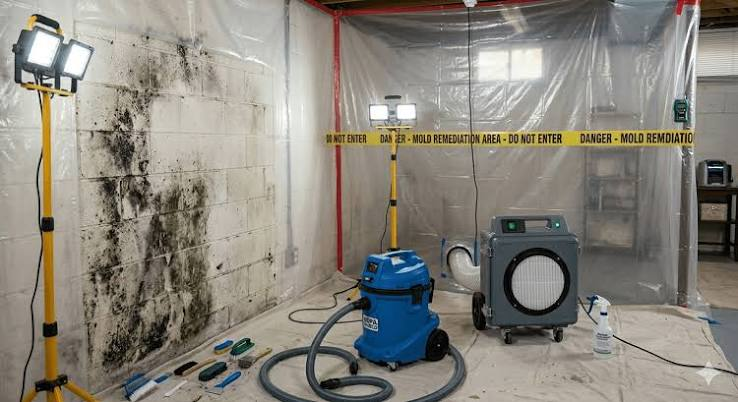
HEPA vacuuming of all accessible surfaces
Damp wiping with appropriate cleaning agents
Cleaning of horizontal and vertical surfaces
Attention to overlooked areas (tops of doors, baseboards, trim, etc.)
In more detailed scenarios, this may extend to:
Contents cleaning (furniture, belongings)
HVAC component cleaning
Repeated cleaning cycles for heavily impacted environments
The goal is simple: remove the particles—not just the visible residue.
Where This Matters Most
Small particle cleaning becomes especially important after:
Mold remediation
Water damage events
Construction or renovation
HVAC contamination
Long-term dust or debris accumulation
In these situations, the environment often contains a higher-than-normal load of fine particulates that need to be addressed directly.
When It’s Skipped
When small particle cleaning is overlooked or incomplete, homeowners may notice:
Persistent dust or debris
Musty or stale odors
Symptoms that don’t fully resolve
Test results that still show elevated spore levels
This can lead to confusion—especially when the original source of mold has already been corrected.
But in many cases, the issue isn’t active growth.
It’s what was left behind.
Clean vs. Truly Clean
There’s a difference between a space that looks clean and one that has been properly returned to a normal fungal ecology.
This is a key concept in the IICRC framework.
A successful outcome isn’t just the absence of visible mold—it’s an environment where:
Particle levels are reduced to normal
Surfaces are free of contamination
The space behaves like a typical indoor environment
Small particle cleaning plays a central role in achieving that outcome.
Moving Forward
If you’ve recently addressed a mold or moisture issue and your home still doesn’t feel quite right, it may be worth considering what remains—not just what was removed.
The final stage of restoring an indoor environment often isn’t dramatic.
It’s detailed. Methodical. And easy to overlook.
But it can make all the difference.
Final Thought
In many homes, the question isn’t just:
“Was the mold removed?”
It’s:
“Was the environment truly cleaned?”
Because when it comes to indoor air quality, the smallest particles often have the biggest impact.
If you’ve completed remediation but your home still doesn’t feel right, the issue may not be active growth—it may be what was left behind. Identifying that difference is key.
Give us a call or check out our webite to learn more


Comments