
Killing Mold Isn’t Remediation: What “Source Removal” Actually Means
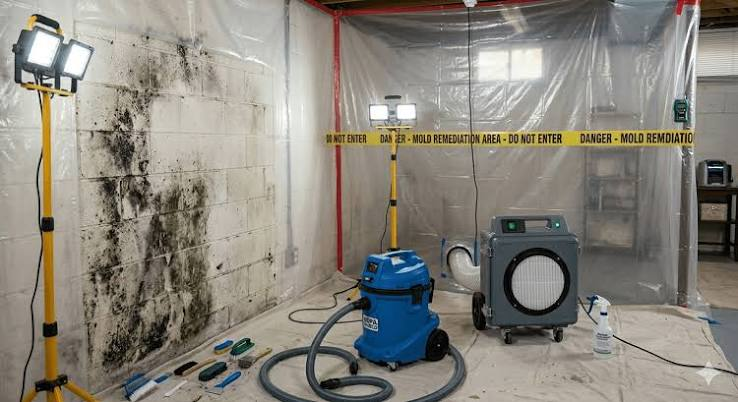
When someone discovers mold in their home, one of the first instincts is often:
“What can I spray on it to kill it?”
Bleach. Mold sprays. Disinfectants. Vinegar. Encapsulating paint. KILZ.
But there's a problem with that question.
When we're talking about proper mold remediation, the primary goal isn't to kill the mold.
It's to remove it.
This concept is called source removal, and understanding the difference between killing mold and removing mold can completely change how you approach a mold problem.
What Is the Mold “Source”?
When we use the word source, we're talking about the material where mold has actually established growth.
Imagine discovering mold growing on a wooden floor joist in your crawlspace.
Those aren't simply random mold spores sitting on the wood.
Under the right conditions, a spore germinates and begins producing hyphae—microscopic filament-like structures that collectively form the fungal growth known as mycelium. The fungus grows along and, depending on the material and organism, into the substrate while utilizing available nutrients.
Eventually, that fungal colony may produce additional spores.
So when you see established mold growth on a building material, you're looking at more than a little dust sitting on the surface.
You have a colonized material.
That's the source.
Source Removal Means Physically Removing the Contamination
Proper remediation focuses on physically removing fungal growth and contaminated material rather than simply applying a product intended to kill it.
How that's accomplished depends heavily on the material.
For a disposable porous material such as mold-contaminated drywall, ceiling tile, or insulation, the appropriate approach is often removal and disposal of the affected material.
For structural materials that need to remain—such as framing lumber—the surface may instead be mechanically cleaned using methods appropriate for the material and condition.
That could include techniques such as:
HEPA vacuuming
Damp wiping
Wire brushing or other mechanical agitation
Sanding
Abrasive cleaning
HEPA-assisted cleaning methods
The appropriate method depends on the substrate, extent of growth, condition of the material, and remediation plan.
The objective is the same:
Remove the fungal growth from the building material.
Why Doesn't Bleach Solve the Problem?
Bleach is probably the most common DIY response to visible mold.
And this is where the difference between killing and removing becomes important.
Even when a chemical successfully inactivates fungal organisms, that does not mean the fungal material has disappeared.
Spores, hyphal fragments, cell-wall components, and other fungal debris can remain on the surface.
In other words:
Dead mold is still mold material.
From an environmental-cleaning perspective, we don't want to simply leave fungal biomass attached to a building material because it has been chemically treated.
We want to physically remove the contamination.
Bleach also isn't equally effective on every material or in every situation. Porous building materials present a very different challenge from hard, nonporous surfaces.
That's why proper remediation isn't simply:
Spray → Kill → Done.
It's:
Correct moisture → Remove contamination → Clean the environment → Verify the result.
What About KILZ?
Here's another scenario we see far too often.
Someone discovers mold on framing or drywall and paints over it with KILZ or another coating.
The discoloration disappears.
The surface looks clean.
Problem solved?
Not necessarily.
Painting over visible fungal growth is not the same thing as removing it.
The fungal material is still underneath the coating.
And if the moisture condition that caused the mold hasn't been corrected, the underlying problem may continue.
A coating can hide the visual evidence of contamination while making it considerably more difficult for a future homeowner, inspector, or remediator to evaluate what is underneath.
Does That Mean Encapsulation Is Always Wrong?
No—and this distinction matters.
Encapsulation and specialty coatings can have appropriate uses after proper remediation or in specific circumstances where the remediation plan calls for them.
But encapsulation should not be used as a substitute for source removal when fungal growth can reasonably be removed.
Think of it this way:
Cleaning first, coating second.
Not:
Coating instead of cleaning.
A remediated structural surface may sometimes receive an appropriate coating as part of the final restoration or moisture-management strategy.
That's very different from rolling paint over active visible mold and calling the job complete.
But What If the Mold Is Dead?
We hear this one frequently:
“They treated it, so the mold is dead.”
Whether the mold is viable is only part of the conversation.
Fungal spores and fragments don't simply vanish when an organism dies.
For individuals who react to fungal allergens or other components of fungal material, viability isn't the only thing that matters.
This is one reason professional remediation guidance emphasizes physical removal of contamination rather than relying exclusively on biocides.
If you spilled a pile of allergenic dust on your kitchen counter, you wouldn't spray it with disinfectant and leave the dust sitting there.
You'd remove it.
Mold contamination should be approached with the same basic logic.
Source Removal Also Means Finding the Moisture Source
There is another half of source removal that's just as important.
Why did the mold grow there in the first place?
Mold growth is a symptom of a moisture problem.
That moisture might come from:
Plumbing leaks
Roof leaks
HVAC condensation
Elevated indoor humidity
Crawlspace moisture
Poor drainage
Groundwater intrusion
Condensation on cold surfaces
Building-envelope problems
Improper drying after a water loss
You can perform beautiful remediation work and still end up with mold again if the moisture source remains.
That's why a good remediation plan addresses both:
The fungal source AND the moisture source.
Remove one without correcting the other, and you may simply be waiting for the problem to return.
What About the Rest of the Room?
Source removal doesn't end the moment the visibly moldy material is gone.
Fungal spores and fragments can become part of settled dust and can be dispersed during both normal occupancy and remediation activities.
That's why proper remediation may also involve:
Containment to reduce the spread of particles into unaffected areas.
HEPA-filtered air control to capture airborne particulate generated during work.
HEPA vacuuming and detailed cleaning to remove settled contamination.
Small-particle cleaning when warranted by the extent of contamination.
And finally, post-remediation verification or clearance to determine whether the remediation goals were actually achieved.
Removing the visible mold while leaving behind a heavily contaminated environment isn't the finish line.
What Should Proper Mold Remediation Look Like?
While every project is different, the overall philosophy is surprisingly simple:
1. Find the moisture problem.
2. Correct the moisture problem.
3. Identify the extent of fungal growth.
4. Remove unsalvageable contaminated materials.
5. Mechanically clean salvageable structural materials.
6. Control and remove particulate generated during remediation.
7. Thoroughly clean the work area.
8. Verify that the remediation was successful.
Notice what's missing?
“Spray everything with something that kills mold.”
Chemicals can have specific applications within remediation, but they shouldn't replace the fundamental goal of physically removing fungal contamination.
Don't Ask “What Kills Mold?”
Ask a better question:
“How are you going to remove it?”
If you're interviewing a mold remediation company, that one question can tell you quite a bit.
If the entire proposed solution revolves around spraying, fogging, painting, or applying a chemical without discussing removal of colonized material, mechanical cleaning, containment, particulate control, and correction of the underlying moisture problem, ask more questions.
Because making mold dead, white, or invisible isn't the same thing as making it gone.
The Great Indoors | Education Over Fear
At The Great Indoors, we believe homeowners deserve to understand what mold remediation is actually supposed to accomplish.
You don't need to fear mold.
But you do need to understand it.
Correct the moisture. Remove the source. Clean the environment. Verify the work.
That's remediation.


Comments